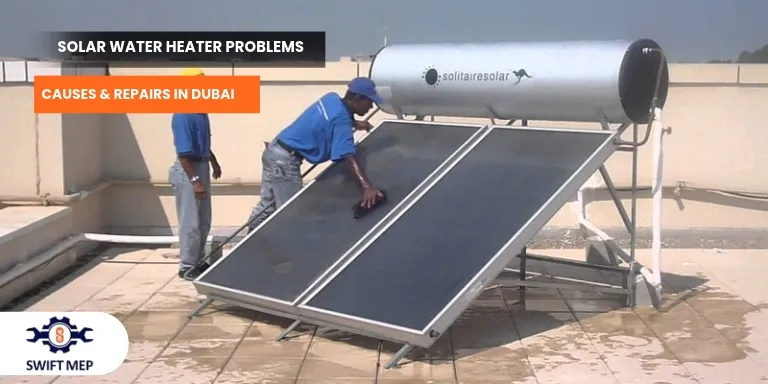
A solar water heater should give you hot water after a sunny Dubai day. But what happens when you turn on the shower and get barely warm water instead? It can be frustrating, especially when your system has had plenty of sunlight.
Most solar water heater problems start with scale buildup, faulty heating elements, leaks, or stuck valves. Some issues are easy to identify, while others need a professional inspection to prevent further damage.
In this guide, we'll explain common problems, their causes, possible fixes, and simple maintenance tips. If your system needs attention, book our water heater repair service for a professional inspection.
How a Solar Water Heater Works (Only the Parts That Fail)
A solar water heater has four main parts:
- A collector
- A storage tank
- A backup heater
- A valves
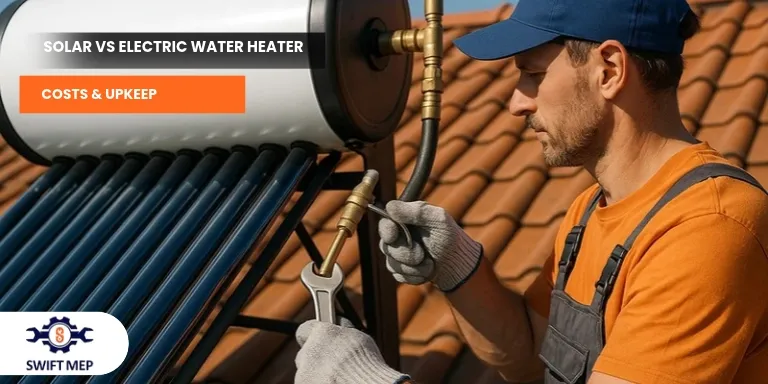
The collector absorbs sunlight, the tank stores heated water, and the backup heater covers cloudy days. Valves keep pressure and temperature in a safe range, and pumped systems add a pump and controller.
Your system type decides which faults you can expect, so check which one you own first.
System type | How it works | Faults to expect |
| Thermosiphon system | The tank sits above the collector, and hot water rises on its own | Scale, leaks, overheating |
| Evacuated tube collector | Sealed glass tubes absorb heat and pass it to the tank | Cracked tubes, scale inside tubes, loose mounts |
| Pumped split system | The tank sits indoors, and a pump moves fluid through the collector | Pump, sensor, controller, and air lock faults |
If the tank sits directly on top of the collectors, you own a thermosiphon system. If you see a small pump and a control box, you own a pumped system.
Quick Symptom Guide: What Each Fault Means
This table lists the most common solar water heater problems, their usual causes, and who should fix them.
Symptom | Likely cause | Fix | DIY or pro |
| Lukewarm or cold water | Tripped breaker, dirty collector, failed thermostat or sensor | Reset breaker once, clean glass, test parts | DIY check, then pro |
| Hot water runs out fast | Scale on the tank or element, weak circulation | Flush and descale, test element | Pro |
| Water far too hot | Summer overheating, failed thermostat, no mixing valve | Test thermostat, fit a mixing valve | Pro |
| Valve dripping | High pressure or heat in the tank | Test valve, replace if stuck | Pro |
| Leak at tank or joints | Corroded tank, worn seals, loose fittings | Replace seals or fittings, or the tank | Pro |
| Knocking or whistling | Scale, trapped steam, trapped air | Flush tank, bleed air | Pro |
| Brown or smelly water | Used-up sacrificial rod, internal rust | Replace rod, flush tank | Pro |
| Cracked glass or loose collector | Heat stress, loose bolts | Replace glass, tighten mounts | Pro (roof access) |
Common Solar Water Heater Problems, Causes, and Repairs
Each problem below lists the symptom, the cause, and the repair, so you can match your case.
Solar Water Heater Not Heating or Only Lukewarm
On a sunny day, lukewarm water usually means a tripped backup circuit or a dirty collector. A failed thermostat, a faulty sensor, or a dead pump can also stop heat reaching the tank. A burnt-out backup heating element leaves the tank cold on cloudy days and in the evening.
Work through these causes in order before you book a visit, starting with the simplest:
- Breaker: Reset the backup heater breaker once, and call us at once if it trips again.
- Collector: Wipe dust off the glass and look for new shade from buildings or trees.
- Controller: Look for error lights on the control box, because they point to a sensor or wiring fault.
- Thermostat or element: A failed part stops the tank heating, and only a technician should test it.
A technician tests the element, thermostat, and sensors with a meter, then replaces the part that fails.
Hot Water Runs Out Too Fast
When hot water lasts half as long as it used to, scale is the first suspect. Heated water leaves hard mineral limescale on the tank walls, the element, and inside collector tubes. A thick layer blocks heat transfer, so the water heats slowly and the element burns out sooner.
Weak circulation and a stuck thermostat can cause the same symptom, so we test all three. The repair is a tank flush and descale, plus new parts if the element has failed.
Water Is Too Hot, or the Valve Keeps Dripping
Summer sun can heat the tank beyond your thermostat setting, and the extra pressure must escape somewhere. That escape route is the pressure relief valve, and a dripping valve signals high pressure or heat. When nobody uses hot water for days, stagnation sets in and the collector keeps heating.
The US Department of Energy says overheating can push fluid out of the relief valve. A tempering valve at the tank outlet mixes in cold water and lowers the temperature at your taps. Replace a stuck or worn valve right away, because it is your tank's main safety device.
Solar Water Heater Leaking
A solar water heater leaking from the tank base, collector joints, or pipes needs attention the same day. Worn seals, loose fittings, and corroded tank walls are common causes, and roof heat loosens joints over time.
Water dripping from the tank base usually means internal corrosion, and the tank then needs replacing. A leaking fitting or seal is a smaller job, and we replace the part and pressure-test the joint. If water is already dripping, call our water leak repair team and switch off the water supply first.
Knocking, Whistling, or Gurgling Noises
Knocking or banging usually means scale, trapped steam, or air moving through the pipes and tank. Whistling often points to a partly closed valve, and gurgling suggests air trapped in the loop. Flushing the tank and bleeding air usually clears these sounds, but a persistent bang needs a proper inspection.
Brown, Rusty, or Smelly Water
Brown or rusty hot water means rust is forming inside the tank or in older pipework. The anode rod inside the tank corrodes first to protect the lining, so a used-up rod invites rust. A rotten-egg smell can also appear, and a tank flush with a fresh rod often clears it.
Pump and Controller Faults (Pumped Systems Only)
A pumped system fails to heat when the circulation pump, the controller, or a sensor stops working. The solar controller compares collector and tank temperatures, then starts the pump when the collector runs hotter. A bad sensor sends wrong readings, so the pump stays off even though the roof is hot.
Air locks and worn bearings also stop flow, so we bleed the loop and replace failed parts.
Cracked Glass, Broken Tubes, and Loose Mounts
A cracked glass cover or a broken tube in an evacuated tube collector lets heat escape. Summer heat expands the metal frame every day, and the constant movement loosens bolts over the years. Collectors sit on a roof, so only a trained technician should replace tubes or retighten mounts.
Why Solar Water Heater Problems Show Up Sooner in Dubai
Dubai gives your system plenty of sun, and that same climate wears parts out faster. These five local factors cause much of the wear we see on roofs across Dubai:
- Mineral scale: Heated water leaves hard deposits that slowly clog tanks, pipes, and collector tubes.
- Dust and sand: A thin film on the glass cuts the sunlight that reaches the absorber.
- Extreme heat and UV: Seals, plastic parts, and insulation harden and crack after years of exposure.
- Coastal humidity: Salty air speeds up rust on roof frames, bolts, and exposed metal fittings.
- Installation quality: Poor fittings, a missing mixing valve, or a blocked relief outlet shorten the system's life.
A Safe 5-Step Check Before You Call a Technician
These five steps take about ten minutes and need no tools, so try them before booking.
- Check the power: Reset the backup heater breaker once, and look for any tripped switches on the board.
- Test the backup: Switch the backup heater on, and confirm that the tank still heats the water.
- Inspect the collectors: Look for dust, shade, cracked glass, or drips around the pipe fittings.
- Check the valves: Make sure the inlet valve is open, and note any dripping from the relief valve.
- Test after a sunny day: Turn the backup off, wait until evening, then run a hot tap.
If the check explains nothing, send us a photo on WhatsApp. We will tell you the safe next step, and our emergency plumbing team can attend urgent leaks.
When to Stop and Call a Professional
Three hazards come with every solar tank, and each one is a good reason to call a professional:
- Scalding: Roof tanks can reach very high temperatures on summer afternoons, so run taps with care.
- Roof work: Dusty collectors are fragile and slippery, and a fall from a roof can cause serious injury.
- Electricity: Backup elements run on mains power, and water near wiring creates a shock risk.
Never block the relief valve outlet or drain a hot tank yourself, because scalding water can escape fast.
Repair or Replace? How to Decide
Repair makes sense when the tank is sound and the fault sits in a part you can swap. Replacement makes more sense when the tank is corroded, leaks from its base, or has failed repeatedly.
Situation | Usually the best choice |
| Failed element, thermostat, sensor, or valve | Repair the part |
| Scale buildup with a sound tank | Flush and descale |
| Cracked glass or a few broken tubes | Replace the damaged parts |
| Tank leaking at the base | Replace the tank |
| Several repairs in a short time | Compare repair and replacement quotes |
Repeated solar water heater problems after several repairs usually mean replacement will cost you less overall.
What Drives the Price of a Repair
Solar water heater repair cost depends on the part, the roof access, and the system type. A valve swap costs far less than a new tank, and an inspection shows which case you face. We give a clear quote after the inspection and explain every part before we start the work.
Ask about warranty on parts and labour before you approve any repair, and keep the written quote.
Solar Water Heater Maintenance Checklist for Dubai Homes
Regular solar water heater maintenance helps prevent many faults and takes less time than a repair. Follow this schedule and keep a simple log, so you can spot slow changes in performance.
How often | Task | Who |
| Monthly | Wipe dust off the collector glass and check for drips or wet marks on the roof | You |
| Every year | Flush the tank, test the relief valve, and check bolts, mounts, and insulation | Technician |
| Every year | Check shade at mid-morning, noon, and mid-afternoon, because new buildings can block the sun | You or technician |
| Every 3 to 5 years | Inspect the anode rod and replace it when it is badly worn | Technician |
Clean the glass in the early morning, because cold water on hot glass can crack it. A yearly professional service stops many solar water heater problems before they ever reach your taps.
How to Choose a Technician for Solar Water Heater Repair in Dubai
Searching solar water heater repair Dubai returns dozens of companies, so ask these questions first:
- Is the company licensed, and can its technicians show you a valid trade licence on request?
- Does the technician inspect the system first, and then explain the cause before quoting any price?
- Has the company repaired your type of system before, whether it is roof-mounted or pumped?
- Does the quote list each part and the labour separately, so you can compare it with others?
A good technician finds the root cause of solar water heater problems, not just the visible fault. We at Swift MEP are licensed Dubai contractors with over five years of experience and 24/7 support. We also explain each fault in plain words, so you know exactly what you are paying for.
Book a Solar Water Heater Inspection With Swift MEP
Contact us now and let us fix your solar water heater problems at the source, not just at the symptom.
Frequently Asked Questions
Why is my solar water heater not heating?
The usual causes are a tripped backup breaker, a dirty or shaded collector, or a failed thermostat. Sensor, pump, and controller faults can also stop heating, so call a technician if the basics look fine.
Why is my solar water heater dripping water?
A dripping valve usually signals high pressure or heat, though a worn valve seat can also cause it. Never cap the valve, because a technician should test it and replace it when it is worn.
How often should I service a solar water heater?
Book a full service once a year, covering the tank flush, valve test, mounts, and sacrificial rod check. Wipe the collector glass every month, because dust steadily cuts the sunlight reaching the absorber.
Can I repair a solar water heater myself?
You can reset a breaker once, wipe the glass, and check that the inlet valve is open. Leave roof work, wiring, valves, and tank repairs to a licensed technician, because scalding water can injure you.
Does a solar water heater work on cloudy days?
Yes, it still works on cloudy days, but the collector absorbs less heat and output drops. The backup heater tops up the temperature, so water that stays cold often points to a backup fault.